Where to start with LAND by Maggie O’Farrell? It is, as one would expect, beautifully written, immaculately researched, and rich with strong and talented women, a speciality in O’Farrell’s books. I had, of course, read her two most recent novels, HAMNET, and THE MARRIAGE PORTRAIT, as well as several of her other titles, including I AM, I AM, I AM, and THE HAND THAT FIRST HELD MINE. I was intrigued to see how she would tackle what sounded like a sweeping family story, rooted in Ireland, but spreading out across the world. It’s a long book at 436 pages, and for the most part, I was fully immersed in the fortunes of Tomas and his family. The novel opens in 1865 as Tomas is working for the Ordnance Survey project to map Ireland, and, in the early pages, he is assisted by his less-than-enthusiastic son, Liam. We also meet his wife, Phina, their daughters, headstrong, tomboy Enda, and more compliant Rose, and - during the course of the book - their youngest son, Eugene, who never speaks. After Tomas has a life-changing mystical ‘experience’ in a copse, and as a consequence, decides to create his own map of Ireland, rather than the British version, the family fortunes change, and he moves them from city to countryside, where they live off the land in an isolated cottage. This is an Ireland still recovering from the Irish Potato Famine in the 1840s and 1850s, when so many starved or left the country. Gradually, tragic events occur within Tomas’s family, and Liam and Enda go their separate ways, crossing variously to the New World (Canada) and to India. In this sense, it is, I think, a realistic re-imagining of the fates of many Irish in the 19th century, who had to go elsewhere to seek new lives. If I had a quizzical thought, or two, it would be that the book could have been slightly shorter, and I was also a little thrown, at the start of Part Two, when the narrative skips back several millennia, to Brith, a girl, and her faithful Irish wolfhound, and a visitation by a talking fish. Whilst I understand that Maggie O’Farrell is weaving Irish myth into her narrative, and the girl, and the dog, do return within the book, for me, it seemed a little jarring within the mainly 19th century narrative. But overall, it was an absorbing read, and O’Farrell’s glorious nature writing, in particular, absolutely sings off the page. I am excited to attend an event at The Irish Centre, in October, and to hear Maggie O’Farrell talk in more depth about the book.
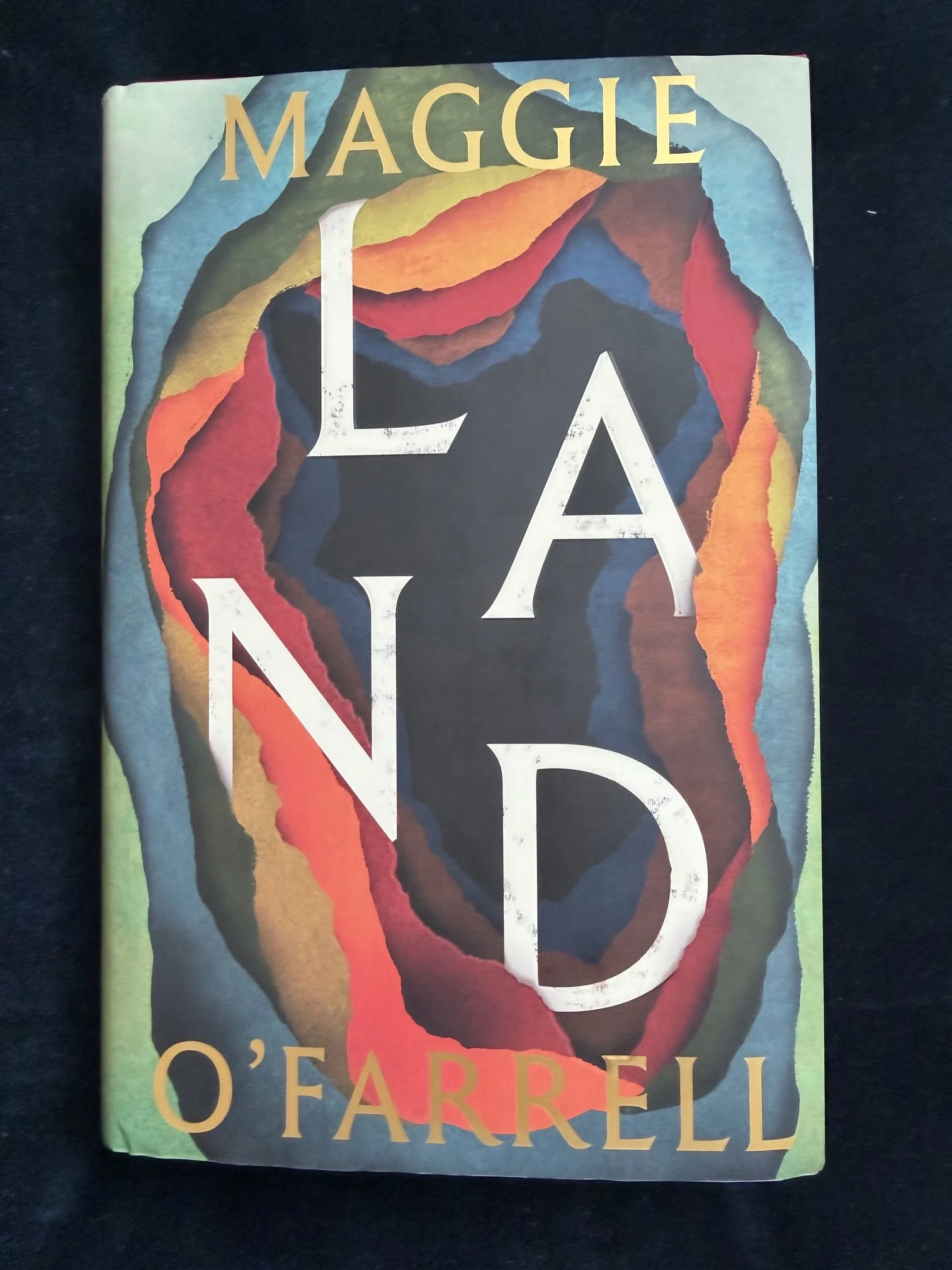
LAND by Maggie O’Farrell (Tinder Press, £25)