THE END OF EVERYTHING by M John Harrison is by turns disturbing, magical, funny, and terrifying. Where to begin? I’m not surprised it has just won The Booker Prize 2026, because if, for one moment, I set aside the confusing future time period in which the novel is set, the prose is quite stunning. As for what the book means - and as readers we are catapulted into a dystopian world that is never fully explained - isn’t the confusion the point, a perplexing future experience that might be coming for all humanity one day? The novel opens with one of its protagonists, Phillip Tennent, beach combing, and finding a ‘being’ in the sea, which he takes ashore, possibly to sell. Later, the ‘being’ is referred to as ‘the artefact’ and it becomes a talking, sentient creature who delivers some delightfully amusing lines. (I actually wished for more time with ‘the artefact’ who was surprisingly well-dressed as a result of forays into charity shops.) We’re also introduced to Marnie, Phillip’s aunt, who is 70 and an artist, originally trained at The Slade. It’s clear we are deep in a future world, where a mysterious entity called the iGhetti has invaded the City of London, meaning that these days, fragmented communities are strung along hollowed out seaside towns. It is also an England where it appears there are no rules, no police, and no government. And yet, as a constant throughout the novel, which has wonderful chapter headings - ‘Marnie dreams of a holiday’ and ‘The things she had in her bag’ being two of my favourites - are the breathtaking descriptions of nature: water and skies and landscape that seems to burst forth despite the country being in a state of dislocation and abandonment. ‘There the chalk swept down to the sea like an arm in a green medieval shield’, and ‘Mist blowing across the hilltop copses, threadbare pine trees on exposed slopes. A mass of chamomile. Orange poppies in the tall brown grass’ particularly spring to mind. The novel weaves back and forth to past events, for example, Phillip’s relationship with a woman named Alice, and his teenage email correspondence with Aunt Marnie, but in the main, as readers, we are kept rooted firmly in the present. Did I mind that, or the apparent lack of conventional plot, or the sense that I didn’t understand everything that was happening? Ultimately, no, because I was prepared to suspend reality, and to go along for the wild, spectacular, imaginative, fractured ride of THE END OF EVERYTHING, whilst soaking up M John Harrison’s glorious prose.
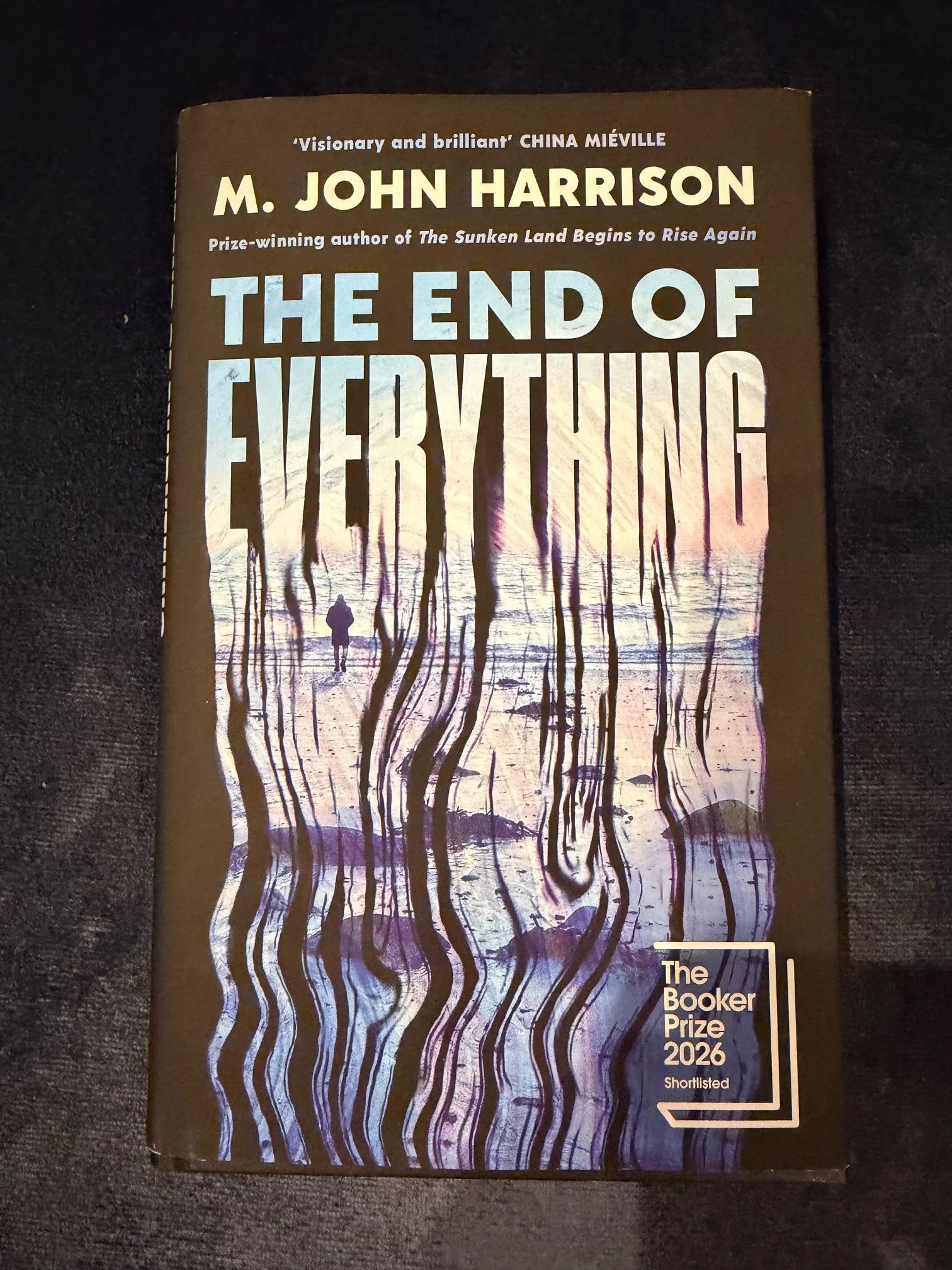
THE END OF EVERYTHING by M John Harrison (Serpent’s Tail, £16.99)