JW: Congratulations on being the winner of The Waterstones Debut Fiction Prize 2026 for your novel MAY WE FEED THE KING (Granta, £14.99). How does that feel?
RP: I’m feeling very lucky, very fortunate … booksellers have so little time, it’s a massive undertaking for them, so it feels like a really lovely prize. It was a huge and very pleasant surprise.’
“After a few months of surviving on pretty small, not overly compelling jobs, I received a commission in my inbox.”
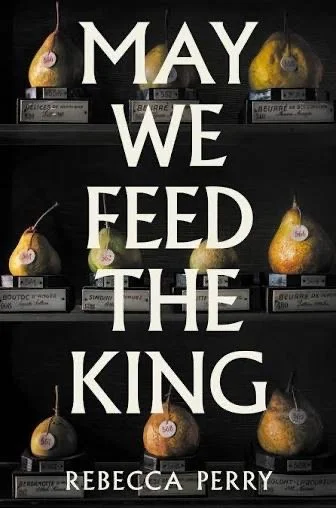
MAY WE FEED THE KING (Granta, £14.99) by Rebecca Perry
JW: Every book begins with an idea, a phrase, or an image. What was your kernel? How did you start to germinate this incredibly original novel?
RP: It started as two short stories. I’d written poetry before, and a lyrical non-fiction work. There wasn’t a moment when I thought: I’m going to sit down and write a novel. That wasn’t my plan. I was hesitant about writing prose, because I’d never done it before, so my way in was through short stories. I was writing one story about a woman obsessed with replica food, who was embarking on a project to create different scenes in her house. She was doing it to invoke people to cohabit with, and I’ve always loved those curated scenes in historic houses. This character later became my curator. But I was also writing a story about ‘the attendant’ to the king; he was the first character in the novel who came to me. I’d suddenly had an idea of a quiet medieval man, looking after a dying king, sitting in a room by himself eating chicken. At a certain point, I thought: the woman is going to create a scene which allows her to access the attendant, and it suddenly became clear that it was the same book.

Rebecca Perry, author of MAY WE FEED THE KING (Granta, £14.99)
JW: Each small section of the novel - or chapter - has an intriguing heading. My favourite is ‘The Colour of Patience is Grey’. Did you create the headings as you went along or add them after ?
RP: It was a combination of both. In the first draft, the chapters alternated between the modern, and the medieval, and there were no section headers, we were just dipping in and out. But after I turned the book into a three-part structure, as I started re-writing, I gave the medieval sections these headings. That’s how the book went out on submission to publishers. Once it had been acquired by Granta, my editor there asked if there was a reason why there were no section headers in the modern, curator part? So I retrospectively added them in. It was a fun process, a bit like giving a title to a poem. In the medieval section, there were already a few jarringly modern titles, and in the contemporary section, I added the opposite, as I started to play a bit more.
JW: I’m a former interiors stylist and I’ve created many sets for shoots. You’ve captured the art and philosophy of scene setting so beautifully – how did you get under the skin of a specialist curator?
RP: I was very much imagining a person, and what their motivation would be. It may sound trite but scene-setting is the same as writing – as a writer, what you want is that people feel in the world of the book, and feel like they’re with the characters. And you can’t control what happens to your book once it’s out in the world. So the two processes share a lot of common preoccupations. It didn’t feel much of a leap to imagine how being super specific about your intention, and how you get there, applies to writing, just as much as it applies to setting the table with plastic. It was very instinctual. I now have a lot more replica stuff in my home that people have given me: a glass apple, a glass pear, two metal pears, and seven ceramic pears that I made myself!
JW: Can you describe your writing process? Are you a multiple drafts person or a perfectionist with a single draft?
RP: I’m not meticulous at all; I fall somewhere in the middle. I edit myself as I go, but this book evolved over time, and changed so much. At different points the document was an absolute mess. Now I’m writing another book, I know what is lying in wait for me, and that feels really difficult. I try to write as well as I can, as I’m doing it. I held onto poetry writing a lot as I was drafting the novel, because in poetry you don’t know what will happen. I had no idea what would happen in this book, I hadn’t structured it. I didn’t do character mapping. I let it be a real mess in terms of ideas, and structure, and all that stuff. It just happened and then I moved things around constantly.
JW: What matters most to you when writing - character, plot, language?
RP: When I first started writing, I thought: this book will have no plot and I didn’t mind that. What I care about is the feeling generated by what you’re reading. So, if I’ve read a particular book, a year or so later I might not remember the plot, or what happened in the traditional sense, but I’ll probably remember how I felt about it. My main concern is that, even if we’re not getting loads of dialogue or pointers about a character’s motivation, it’s important to me that it’s not just a nice read, but that it leaves the reader with a feeling. Also, I care a lot about how I use the space on the page. A traditional linear narrative arc is not interesting to me. Sometimes I love to read it, but I wouldn’t be able to write it.
JW: The language in MAY WE FEED THE KING is highly poetic and intricate, and has been described by reviewers as ‘sumptuous’ and ‘enchanting’. Is this style specific to this book or is it in your writing DNA?
RP: That’s a really interesting question. My motivations are the same: in my poetry, I resist things that are incredibly clear, and I enjoy writing poetry and prose that is generous and inviting. I don’t want to hold a reader far away, and I don’t want to be oblique and unclear, or hide my meaning too much. I like oddity and I enjoy strangeness and those things that exist in the halfway between thoughts. Some of my poetry is more straightforward, but there’s also weirder stuff, which is more about feeling. It’s true that with the book I wanted to resist giving answers. My hope was that readers would do a lot of the imaginative work themselves and fill in lots of gaps, which I think is usually what poetry is demanding. You’re asking them to come on a journey with you and trust you as a writer. I wanted to carry the spirit of poetry into prose. That’s why I didn’t really describe anyone in the book, or set it in a particular place or time. I didn’t age anyone, none of that stuff. I wanted it to be an enjoyable thing for readers to create their own cast, and to do a lot of visual work in their brain. Exactly as the curator does in the book.
JW: The curator withholds a lot; we don’t know what has happened to her in the past. Was this deliberate? As the novel progressed, I felt there was potential for a love story with the archivist but it’s subtle, isn’t it?
RP: In the first draft of the book, when it went out on submission, the relationship between the curator and the archivist was even less well developed. I wanted the process of the curator ‘finding’ the king to be a re-entering into her own life, her way back into the world. That, in some way, the project would bring her to life again. My editor and I thought it would be good to be more explicit. Once I started poking at their relationship, it made sense. In the finished book, there’s much more, even though it’s still minimal!
JW: Much of your evocative imagery is rooted in food and gardens. Are these your passions in real life?
RP: I’m a big gardener, I have an allotment; it’s one of my greatest joys. I could never write a novel that was industrial or post-apocalyptic. I need sensual, visual things in my writing. I love food and my partner is a chef, so I’m regularly looking at incredibly beautiful food that’s been prepared. In the book, there isn’t ever a great overarching description of where we are, in terms of the palace, so - in what could otherwise be a wilderness of a book - I wanted to dot around descriptions of fabric, or part of a garden, or a tiny section of a table. For there to be anchor points for readers, where they could have an incredibly visual experience, and feel the world is real, even though they’ve no idea where they are. So, using these snatches of food and flowers was a mechanism for that, as well as being really enjoyable to write.
JW: Can you elaborate on the reluctant king who is thrust into power? How did you develop him?
RP: So much historical fiction is written about people who hold positions of power, but I’m drawn to characters who are put into completely unfathomable positions. The idea of absolute monarchy is very interesting to me, and the notion that, overnight, a single person can suddenly have the power to do whatever they want. So, I was curious about an individual being forced into that role, with no desire to have that power. We often hear about glorious rulers or inept rulers - stereotypes - but I wanted to take something that’s been written about so much, and look at it differently. I was drawn to the character of an unprepared pacifist king, at odds with the world, but I also wanted to examine that in parallel to the curator. They’re both people rubbing up awkwardly to their positions. While I was writing the book, all sorts of dreadful things were happening in the world, at the hands of men with way too much power. That definitely fed into the way I created him and my interest in resistance to violence and absolute power. As I wrote the king, he evolved on the page, and I ended up loving him a lot. I missed being in his company when the book was finished. He’s just a gentle boy!
JW: In the medieval sections, palace gossip is often represented in single line questions, or snippets of unattributed dialogue strung across the page. You’re playing with form; it has the look of poetry. Was the manuscript like this when it went out on submission?
RP: Yes, it was always like that. The book was always in very short sections, and I wanted to create this feeling of walking past a door and hearing just one sentence, and then walking down the corridor and hearing one more. I always knew I wasn’t going to have speech marks, or ‘he said/she said’. I wanted the dialogue to be floating around on the page, little snippets to be grabbed by the reader.
JW: Did you get an agent after you’d written the book and was Granta your dream publisher?
RP: When I was writing poetry, I didn’t have an agent. Once I had a pitch for the novel, I approached agents I thought would be interested and I signed with Seren Adams. She now has her own agency called Lexington Literary. We worked on the novel together for, I guess, a year and a half. In the original draft, the modern section was still the woman scene-setting in her own house, and my agent queried this. So, the woman became a curator, and then I went away for a while, and rewrote the modern section. After I sent it back, it was probably about 80% finished. We went out on submission and I was really lucky to have three publishers interested. I knew I wanted an independent publisher, and Granta is Granta! I love so many of their writers. I had a really amazing conversation with Dan Bird, who would become my editor; we both felt very energised by our discussion. I could tell that he loved the book, but he also had lots of questions, so I knew he would challenge me. Dan and I worked together on the manuscript, and I probably added around 5000 words, just building out certain things, with his encouragement.
JW: Did it feel exposing, or exciting, when the novel was published?
RP: I was excited. I did a lot of work to keep my expectations low, which is easy to do if your background is in poetry! I thought: this is a weird book, if some people like it, that would be really nice. Even three years ago I’d never have imagined I could write a novel and that it would be published. I am pragmatic generally, and resilient. One of the beautiful things about books is that everyone responds to them completely differently.
JW: Where were you when you heard you’d been shortlisted for The Waterstones Debut Fiction Prize 2026?
RP: Sitting at my desk working, which is usually what I’m doing. I got an email and my editor said something like: ‘We’ve been hoping to hear about this for a while’. It felt so unexpected, because you have to distance yourself from prize stuff, otherwise you’d go mad. Because it’s an award chosen by booksellers, it feels special, in lots of ways, because they’re reading more books than anyone else, and giving so much to the industry.
JW: How do you fit your writing around having a full-time job?
RP: I don’t have a routine. Precisely because this novel was in short sections, it was easier to dip in and out. I bought a tiny Bluetooth keyboard that linked up to my phone, and whenever I was on a train, I’d turn my phone round and work on the keyboard, perhaps for half an hour. Once the book took form, I wrote in the bath. I’d finish work, perhaps do yoga, then get in: it’s an enforced containment. I probably wrote 90% of the book in the bath! I have a wooden tray, with my laptop on it, and my bathroom looks over my garden. Usually one of my cats sits on the edge of the bath, too, so pretty much all of it happened there.
JW: Are you writing another novel, and is it historical?
RP: I started something before MAY WE FEED THE KING came out; it felt like a sensible thing to do. I’ve probably only written about 4000 words, it’s still a loose idea, set in an earlier time period than the current novel. Let’s see what happens …
To read my review of MAY WE FEED THE KING by Rebecca Perry, head over to the Book reviews tab …