Sixty minutes with … Graeme Macrae Burnet, author of BENBECULA (Birlinn, £12)
JW: In 2026, BENBECULA was shortlisted for the Walter Scott Prize for Historical Fiction and the Australian Crime Writers’ Association Prize for Best International Crime Fiction, and longlisted for the Highland Book Prize and the Crime Writers’ Association Historical Dagger. You’ve previously been Booker Prize short- and long-listed for your novels, HIS BLOODY PROJECT and CASE STUDY. Do literary prizes still matter to you?
GMB: They absolutely do! It’s a tricky one, because I don’t write with a reader in mind, or because I want to win a prize. I’m fortunate that I can write the novels I want to write. I get my fair share of critical attention, which is at a premium for every writer. Even so, prizes can shine a light on books that are a bit under the radar. I’ve also worked with small, independent publishers who don’t necessarily have the big budgets that other publishers do, so prizes are very important to me. These things circulate on social media, and people look at prize lists, so it’s about visibility. If you’re on the longlist, you want to be on the shortlist, and if you’re on the shortlist, you want to win.
“My name is Malcolm MacPhee. If you’re wondering why it falls to me to tell this tale, it is for no other reason than this - I am the only one left.”
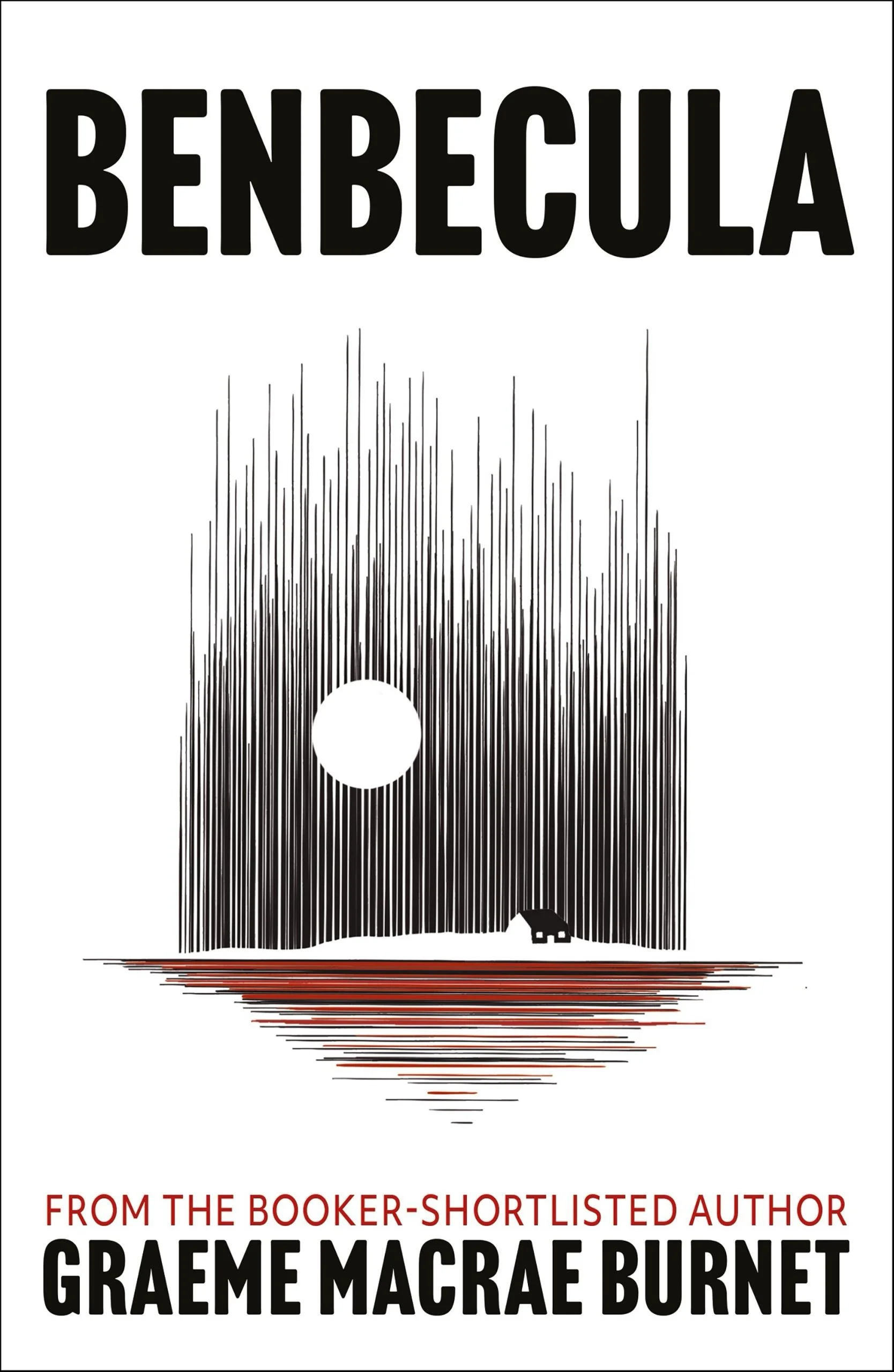
BENBECULA (Birlinn, £12) by Graeme Macrae Burnet
JW: BENBECULA is part of Birlinn’s series, The Darkland Tales, and sits alongside titles by writers such as Val McDermid. How did writing a book for The Darkland Tales come about?
GMB: I was approached by James Crawford, the commissioning editor for The Darkland Tales at Birlinn; he’s also the Chair of the Board of the Edinburgh International Book Festival and he presents ‘Take Four Books’ on Radio 4 – a busy man! The Darkland Tales series has had a lot of visibility in Scotland: they’re novellas all based on a true incident or real characters from Scottish history but written in a fictional way. I was really pleased to be asked to write one. Jamie asked if I had an idea, and I said: ‘Well, actually, there’s a nineteenth century triple murder case I came across whilst researching my historical novel HIS BLOODY PROJECT, which I think is worth investigating.’ He said that sounded interesting, so I did the research, to find out if there were enough bones to put the meat on, and I felt that there were.
JW: BENBECULA is a brief read - it might be described as a short novel, or as a novella. How would you define it? Did its brevity dictate the form of the prose in any way?
GMB: Either is fine, what’s the definition? I love a short novel, and I love a novella. The Darkland Tales are slim volumes, so they were looking for something around 35,000 words. This is where a wee bit of experience comes in. Once I started writing, I knew the book was going to land at about 35,000 words. This was the perfect length for the material I had. BENBECULA is almost an internal monologue, and its relative shortness allowed me to be a bit more experimental. I was keen not to signify the switching back and forth from past to present, using chapter headings or numbers, and within a relatively short piece of work, you can have an element of disorientation. I don’t mind the reader feeling a bit discombobulated. There’s less punctuation than in conventional prose. This is because the handwritten witness statements I read from the archive, held in the National Records of Scotland, Edinburgh, were completely unpunctuated, with no quotation marks, and very few commas, so I wanted to mimic that in the novel. Another reason for dispensing with direct speech was because, late in the book, Angus MacPhee, the murderer, delivers a very long monologue, discussing his crimes. It’s a splurgy, stream-of-consciousness piece of writing. I didn’t want to separate it from other parts of the text by closing it off with inverted commas, because this would have relegated its status from the narrational voice. I wanted all the voices in the novel to be equal.
JW: How long did it take to write BENBECULA, given its brevity?
GMB: The book was written pretty quickly. I was commissioned by James in September 2024, and it was published in October 2025. It was written over the winter months, and I had a full draft by the end of April or early May. That is incredibly fast from a publishing point of view. But in a way, I think it’s important to build up momentum with a piece of writing and to keep going. If you have too many breaks, and you come back to it, self-doubt can take hold, but if it is written quite quickly, and when you go back consistently to a piece of writing, hopefully you’re not becoming inconsistent.
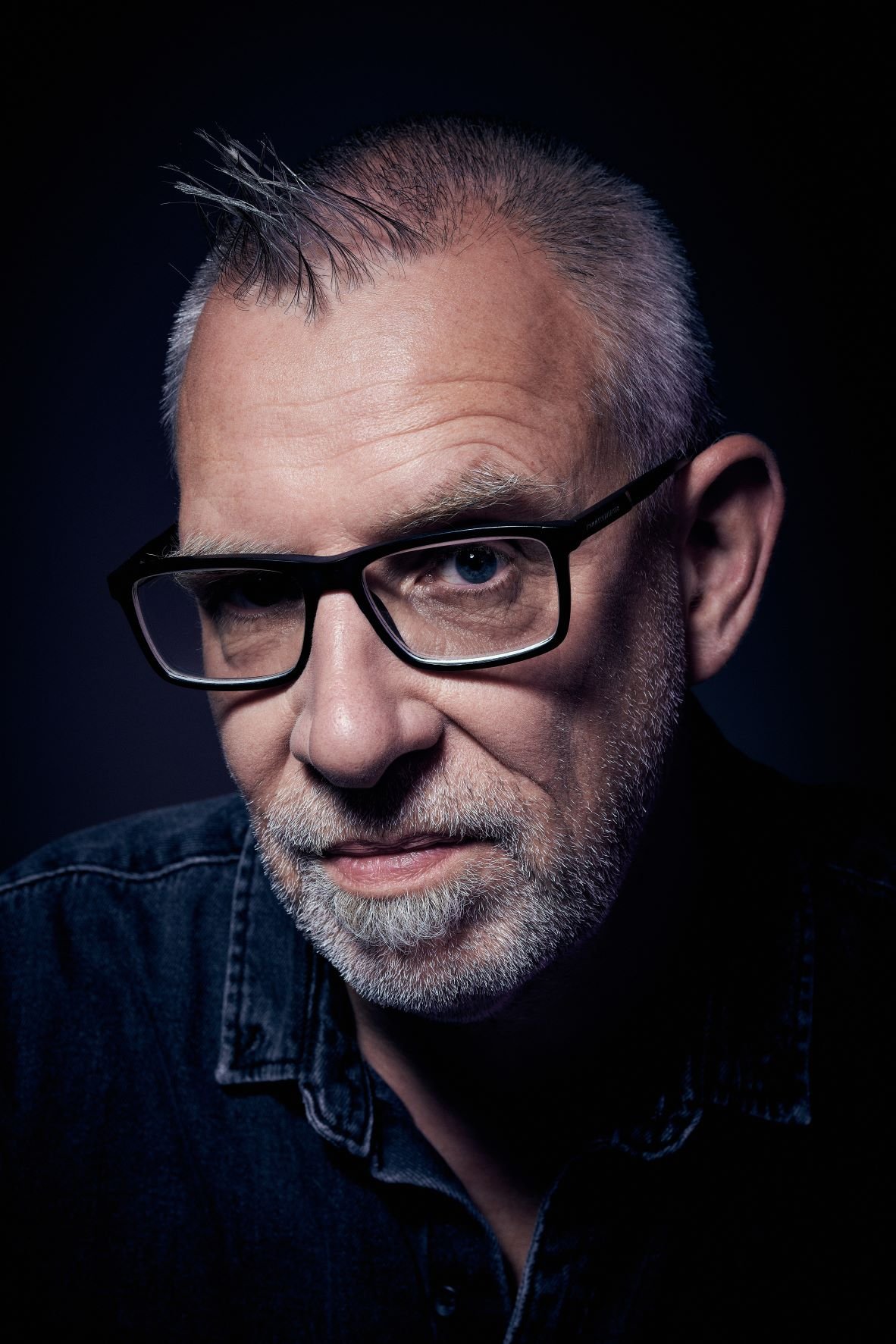
Graeme Macrae Burnet, photograph © Euan Anderson
JW: Malcolm MacPhee, the murderer’s surviving brother, narrates with a very strong, consistent voice, and a wry sense of humour. Did the voice come quickly, or did you experiment and think it over?
GMB: I never sit down and think. I’m not that kind of writer. Thinking in the abstract about what I’m doing doesn’t help me in any way. I’m completely instinctive and I don’t even remember making the decision to tell the story from Malcolm’s point of view. I do remember, however, going to Kelvingrove Park in Glasgow, on a lovely sunny day, with my notebook. (I use regular A4 notebooks, one for each of my novels, except I’ve lost this piece of writing, which is really upsetting.) I wrote: ‘My name is Malcom MacPhee. If you’re wondering why it falls to me to tell this tale, it is for no other reason than this – I am the only one left.’ So, the voice was there right from that opening sentence. Ideas come to me as I write, the physical act , whether that’s typing or longhand. This wasn’t my first venture into writing a character from the nineteenth century. I’d already written HIS BLOODY PROJECT, a fictional account of a triple murder, and for that, I did a lot of research into the way of life in the Highlands at that time. So I had what I call my ‘emporium of words’, words I’d come across in my research. A lot of that vocabulary crossed over from there.
JW: In one sense, BENBECULA is an examination of the nature of madness and/or insanity. Your novel CASE STUDY, set in the 1960s and dealing with a psychotherapist and his female client, also focusses on insanity. What attracts you to the topic?
GMB: That’s a good question. I don’t think I’m particularly interested in murder. But I’ve been reading books about madness and insanity since I was a student. CASE STUDY was inspired by reading psychiatric case studies over many years. If there is a fine line between insanity and sanity, I’m interested in where do we draw it? The first book I ever read on this subject was Michel Foucault’s MADNESS AND CIVILIZATION. That book looks at how, in different periods of history, societies and cultures defined madness. So, it was my first introduction to the idea that madness is not a ‘fixed’ thing. It’s a thing that is defined by the dominant discourse of society. So, if that’s a religious society, and you don’t believe in God, you’re deemed to be insane. If you’re in a society that is highly materialistic and you’re poor, you might be labelled mad. Madness is a reflection of the preoccupations of a given society. I’m also interested in how the psychiatric establishment exerts power, and in men exerting power over women. So, yes, I do come back again and again to characters on the edge of sanity.
JW: Your prose in BENBECULA, whilst being spare and restrained, bristles with period authenticity. It also struck me as being filmic in nature. Phrases such as ‘Mrs MacIsaac never wears a bonnet and her red hair flies wildly about her head’ and ‘Mrs MacAskill walks at a snail’s pace pausing often to gaze out to the sea’, spring to mind. Was this highly visual quality intentional?
GMB: When I’m writing prose, I want the reader to have a very clear visual picture of where the action is taking place. And it doesn’t matter if their picture isn’t the same as my picture. There’s actually very little description in this book. Early on, Malcolm MacPhee tells us: ‘We are an island and a small one at that. The land is flat and sodden’ and that’s about it. But regardless of whether the place I’m writing about is real, or not real, as a writer I have an incredibly clear visual picture of it. I’m glad you quoted Malcolm’s observance of Mrs MacAskill, and the way she looks out to sea. It’s almost a tiny short story in itself. Malcolm won’t think about why she does this, but we might wonder why she gazes out to sea. I love it when people comment that the prose feels filmic, they mean it is a compliment, because they can see in their head the locations of the book. I do love film (especially European art house, that’s my bag).
JW: Can you share a little about your writing process? Do you create a clean first draft or edit across multiple drafts?
GMB: I don’t think anybody is a clean first-drafter. I wouldn’t want to be. It’s important to be completely free at the start. To me, it’s a constant process of evolution, I could never tell someone how many drafts of a novel I’d written. At what point does one draft end and another begin? I always try to get to the end first: I like to push on, generally speaking, because I don’t know what’s going to happen. To me, all the magic occurs in the first draft. This is where the spontaneity is, when things happen that you had no idea were going to happen, and you’re like, oh my God, this character is going to be connected to that character. You piece it together. Subsequent drafts are about tightening things and improving the prose, avoiding lazy use of language and so on. I wrote Angus’s confession/monologue in one night. It’s 3000 words, which for me is a colossal amount of writing. I wanted it to have the feeling of the words are tumbling out of this man, and I drank a bottle of red wine while I was writing it (not my normal practice!) It's all about giving yourself that feeling of freedom and liberation. Of course, I’ve been over that passage, but it remained pretty unedited. I can see the repetition, but I didn’t want to edit that out, because it’s as if he’s searching for phrases and words. I didn’t want to remove the spontaneity of its ‘first draft-ness’. There’s a balance to be struck. You can edit the life out of something by making it too perfect.
JW: The island of Benbecula is in the Scottish Outer Hebrides, and the landscape, the smells, the hard graft of the work on the land, they’re all beautifully realised in the prose. Did you visit the island, and was that an important part of writing the book?
GMB: In the archive, at the National Records of Scotland, I found all the witness statements of the real trial, and these gave me the spine of Angus’s story; everything that happens to him in the novel is based on those documents. But I also found a hand drawn map of the murder location. I’d never visited Benbecula, so I went in January 2025, taking the map, to find the murder cottages. On the map, there are only two sets of cottages; it’s not a village, settlements were scattered along the coastline. I also looked at an 1851 ordnance survey map, and there are only two sets of cottages. When I arrived at that very desolate landscape, there were two sets of ruins, so I was able to put myself in the cottages where these murders happened. I could stand there and look out to sea, and I thought, this is the place that Malcolm calls his ‘Skull House’. So, yes, it was very important for me to go there and put myself in Malcolm’s shoes. The descriptions of the people passing along the shore totally came out of that experience. I wouldn’t have felt comfortable writing the book if I hadn’t visited the island. I went to find the cottages - that was a real bonus. Proper research!
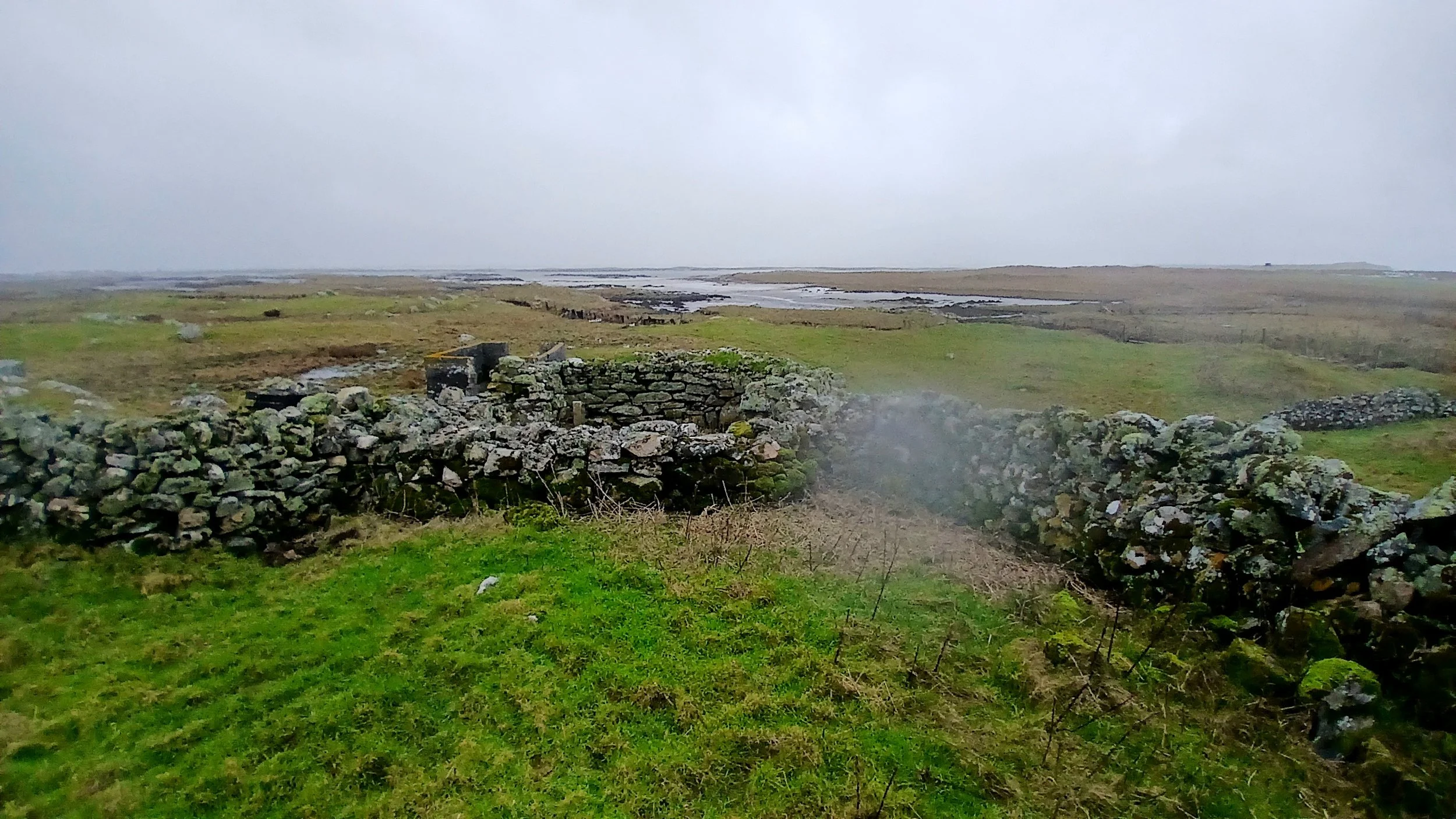
The view Malcolm MacPhee would have had, on the island of Benbecula (photo © Graeme Macrae Burnet)
JW: The fate of some of the characters – in particular of Marion, Malcolm’s feisty sister, who disappears - is left hanging. Was this a deliberate authorial choice?
GMB: All my books have unresolved elements. I don’t do it in a cynical way, or because I want ‘people not to know’. But I like it when readers are left wondering. I don’t want them to finish one of my books, turn off the light and go to sleep. I prefer people to go: what just happened there, what have I been reading, was any of that true? You ask me what happened to Marion? As the author, I don’t want to definitively answer that question! The evidence as presented in the book suggests that something may have befallen her. And we’ve only got Malcolm to tell us the story. If he’s done something bad, he’s not going to tell us, is he? Plus, in the final moments of the book, he’s clearly lost it, because he’s hiding under the bed. I leave it for the reader to decide. Book groups loved HIS BLOODY PROJECT, for example, because we never really know why the main character, Roddy, commits the murders, and it gives people something to discuss. As a reader, I certainly don’t want to be told what to think. Why would you want everything tied up neatly at the end of a novel?
JW: Malcom MacPhee isn’t a particularly likeable character, in fact, he’s very creepy, but his relationship with Mrs MacLeod struck me as particularly tender. Or did I misunderstand that?
GMB: I don’t believe in misunderstanding. There is the story, you’re a reader, and you relate to the characters in one way or another. One of the early sentences I wrote at Kelvingrove Park was: ‘I’m only visited by the priest and Mrs MacLeod.’ And later, when writing, I thought, ah, Mrs MacLeod is here now, what’s going to happen? I just write the scenes and then they develop. Yes, there’s a certain intimacy between these two characters. There’s a moment when Mrs MacLeod cuts Malcolm’s beard. When I was writing, I thought, my God, there’s so much sadness here. Nobody has touched this man in any way, he’s alone, and this good woman from the community comes and tends to him, and she touches his head. I felt emotion, writing those parts. That’s what I mean by the magic of the first draft. When I sat down to write this scene, I didn’t know that was going to happen; I didn’t plan it. As I was writing it, I was thinking, OK, she’s going to cut his hair with rusty scissors, and that was something I didn’t anticipate. Such moments don’t occur when you’re writing later drafts, or at least, they don’t for me. In later drafts, instead, you might lean into something a little or pull back. It’s true that in this relationship, there’s an element of menace for what Malcolm might at some point do to Mrs MacLeod, or try to do to her, but there’s also tenderness. If I’m aiming for anything, it’s for a degree of complexity and ambiguity. I don’t want to write a character who is only menacing, or has unpleasant thoughts. It’s much more interesting if you’re writing a character who is menacing, but who also makes the reader feel something for him or her. That’s a more exciting process for the reader.
JW: When writing fiction based on historical events, does the research come first, then at a certain point you put it aside and write?
GMB: When I first spoke with Jamie Crawford, there was almost nothing written about the triple murders on Benbecula, just a few pages in a book about 19th century crime in Scotland. So, I went to the archive to see what material was there. That’s when I came across the witness statements, which run to about 130pp. I pieced together the events leading up to Angus’s murders; everything in the novel for these parts is based on the real events, even the moment when Angus rings the chapel bell and appears to be deranged. When I read that in the witness statements, I couldn’t believe it, it seemed so potent with symbolism! (And I hate symbolism.) As an author, there’s the story, and then there’s how you tell the story, so the decision to tell the story from Malcolm’s point of view was crucial. When I was writing the scenes with Angus, based on fact, I felt quite shackled, perhaps because I wanted to be true to my understanding of what had happened. When something cropped up in the writing that I didn’t expect, that was more difficult, as I was trying to bring scenes to life novelistically, but I felt constrained by the facts. From the word go, all the scenes with Malcolm and his siblings were completely fictional, so I felt a certain liberation. After a while, the research melts away and you become a little more loose.
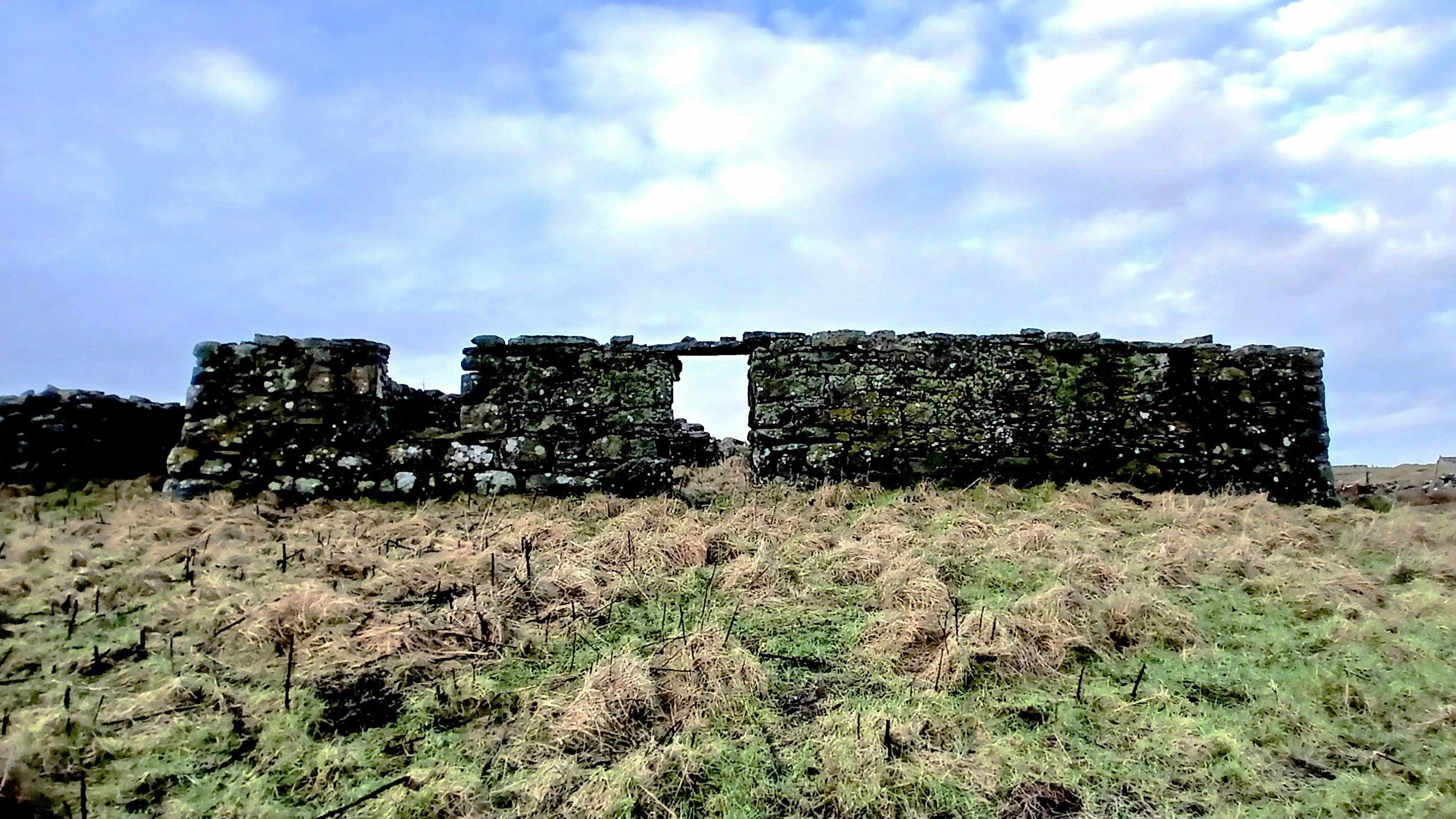
The ruins at Liniclate, on Benbecula (photo © Graeme Macrae Burnet)
JW: I was surprised, on finishing the novel, to find a long Afterword detailing your research. Was that a stipulation for The Darklands Tales series?
GMB: The Afterword runs to about 6000 words, but no, it wasn’t a stipulation. In The Darklands series, some of the tales are well-known stories, and the books tackle events that readers, at least in Scotland, would already have some knowledge of. This wasn’t the case for BENBECULA, because the murders were barely written about at the time; there were only two contemporary newspaper articles. Therefore, because no reader would know the facts, I wanted to set out what actually happened. That’s why the Afterword is there: it was written specifically because of the series. In retrospect, I’m not sure it’s necessary, but I was so excited by the research I’d done, over an intense period, that I wanted to include it.
JW: What are you writing now, and can you tell us a little bit about it?
GMB: The novel I’m working on now is ‘a big thing’, a massive sprawling project that’s probably going to take me a minimum of three years to write, if it comes to fruition. So, I’m very reluctant to talk about the specifics. My confidence in what I’m writing always feels so fragile, it’s like a chick, one that needs to be nurtured at the moment. It can’t be exposed to the hostile world.
You can read my review of BENBECULA here
For more on Graeme Macrae Burnet, visit his website here